
Reference
Seiko
Prospex SPB143
A 2020 Prospex diver that reinterprets Seiko's 1965 62MAS in a 40.5 mm steel case with an in-house 6R35 automatic movement and 200-meter water resistance.
Overview
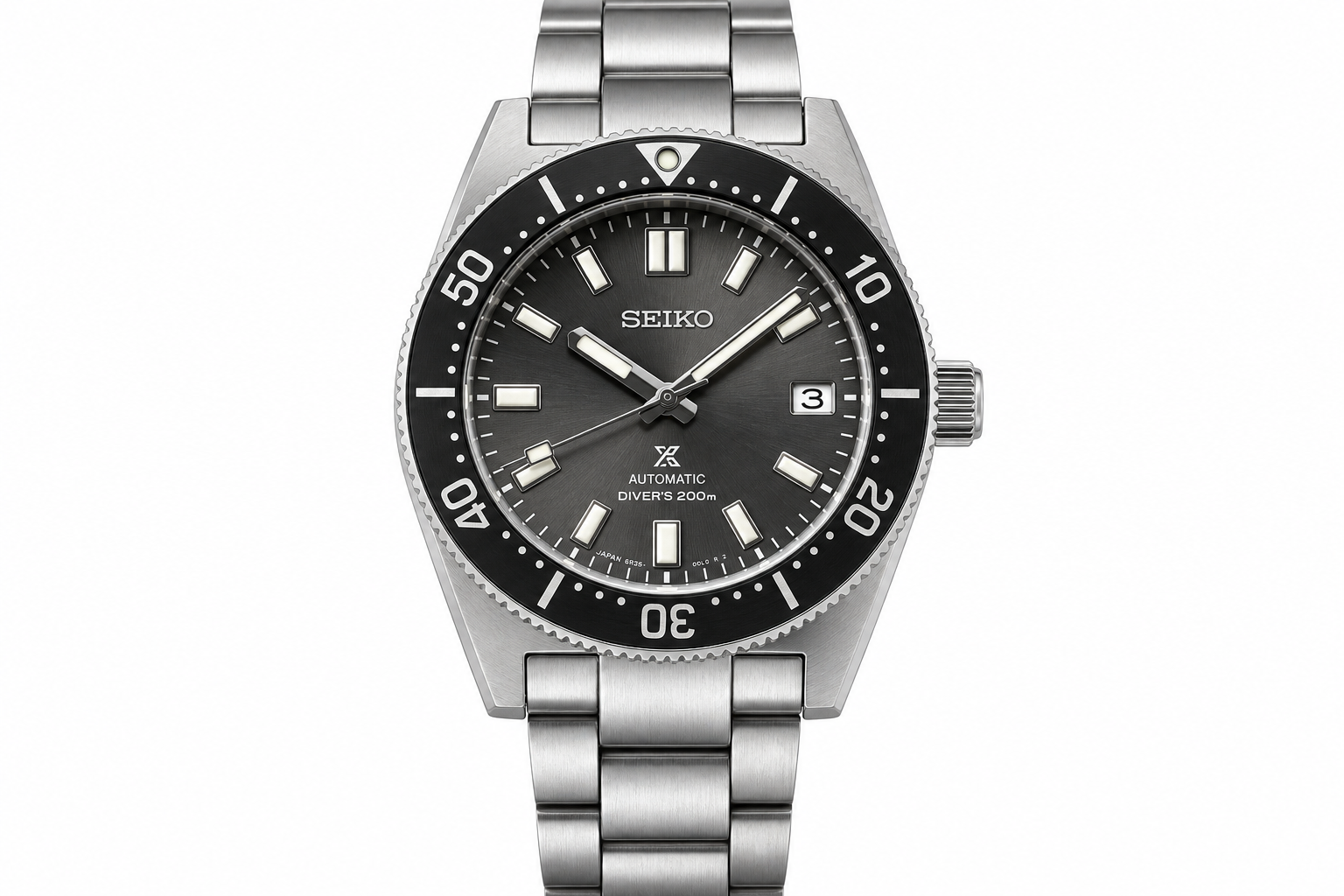
The Seiko Prospex SPB143 is a stainless-steel dive watch introduced in July 2020 as part of a four-model collection revisiting the design language of the 62MAS — the reference 6217-8000/1 that Seiko released in 1965 and widely regarded as the company's first purpose-built diver's watch. Among that quartet, the SPB143 occupies the most direct position: a grey-dial variant on a steel bracelet, intended as a regular-production model rather than a limited edition.
Where Seiko's 2017 SLA017 offered a high-fidelity, premium re-creation of the 62MAS at a substantially higher price, the SPB143 translates the same historical reference into a more accessible package. It pairs a 40.5 mm case with 200-meter water resistance, a curved sapphire crystal, and the in-house Caliber 6R35. The result is a daily-wear diver aimed at enthusiasts who value historical context and in-house movement technology without entering Swiss-luxury pricing.
In international markets, the SPB143 corresponds to the Japan-domestic reference SBDC101 — a naming convention Seiko has used across Prospex lines for decades. Both share the same specifications and grey-dial configuration.
Why It Matters
The SPB143 matters because it occupies a specific and influential position in modern enthusiast watch culture: the sub-$2,000 in-house diver with genuine manufacturer heritage. Seiko's dive-watch lineage is among the most documented in the industry, stretching from Antarctic research expeditions in the 1960s through professional saturation diving in the 1970s. The SPB143 makes that lineage wearable and purchasable without the scarcity or cost of Seiko's higher-tier re-issues.
Its 40.5 mm case dimensions also arrived at a moment when the enthusiast community was pushing back against progressively larger tool watches. By sizing the SPB14x line below 41 mm with a sub-48 mm lug-to-lug span, Seiko addressed a documented preference for more restrained proportions — a decision that contributed to the model's sustained discussion in forums, reviews, and recommendation threads.
Objectively, the SPB143 is not a reproduction of the 62MAS. It is a re-interpretation: the dial layout, handset geometry, and bezel profile echo the 1965 original, while the movement, crystal, coating technology, and water-resistance rating reflect six decades of manufacturing development. Understanding that distinction is central to evaluating the watch on its own terms.
History
Seiko introduced the 62MAS in 1965 with 150-meter water resistance, a bidirectional rotating bezel, and a calibre 6217A automatic movement. It was developed during a period when Seiko was establishing its credentials in sports and professional timekeeping, and it preceded the landmark 6105 and 6309 divers that would define the brand's tool-watch identity through the 1970s and 1980s.
The 62MAS remained a reference point in Seiko's archives rather than a continuous production model. Decades later, the 2017 Prospex SLA017 — produced in a limited run of 2,000 pieces — demonstrated market appetite for a faithful, premium re-creation. That release validated the design but left a price gap between entry-level Seiko divers and the roughly $4,000 SLA017.
Seiko addressed that gap in 2020, announcing the SPB143, SPB145, SPB147, and SPB149 as part of the 55th-anniversary celebration of its first diver's watch. All four share the same case and movement; they differ in dial color, handset finishing, lume tone, and strap or bracelet configuration. The SPB143 and SPB145 ship on steel bracelets; the SPB147 on a silicone strap; the SPB149 — limited to 5,500 pieces — on both, with a dark-blue dial.
Launch pricing placed the bracelet-equipped SPB143 at $1,200 USD. Enthusiast publications received the line favorably, with particular attention to case finishing, the upgraded 6R35 movement, and wearability. The model entered Seiko's permanent Prospex catalog rather than a limited-production cycle, which has made it one of the more commonly encountered mid-tier Seiko divers in secondary markets.
Specifications
| Reference | SPB143 (international); SBDC101 (Japan domestic) |
|---|---|
| Collection | Prospex — 1965 Heritage Diver's Watch |
| Introduction | July 2020 |
| Case Material | Stainless steel with Seiko super-hard coating |
| Case Diameter | 40.5 mm |
| Case Thickness | 13.2 mm |
| Lug-to-Lug | 47.6 mm |
| Lug Width | 20 mm |
| Lug Holes | Drilled |
| Bezel | Unidirectional rotating, 60-minute scale |
| Crown | Screw-down, crown at 3 o'clock |
| Caseback | Solid, screw-down |
| Crystal | Curved sapphire with anti-reflective coating (inner surface) |
| Dial | Grey, sunburst finish |
| Lume | LumiBrite on hands, indices, and bezel marker |
| Water Resistance | 200 meters (660 feet) |
| Movement | Seiko Caliber 6R35 |
| Movement Type | Automatic with manual winding |
| Frequency | 21,600 vibrations per hour (3 Hz) |
| Jewels | 24 |
| Power Reserve | Approximately 70 hours |
| Accuracy (factory rating) | +25 to −15 seconds per day |
| Functions | Hours, minutes, seconds, date; hacking seconds |
| Bracelet | Stainless steel three-link |
| Clasp | Three-fold with secure lock, push-button release, and extender |
| Weight (on bracelet) | 180 g |
| Launch MSRP | $1,200 USD (2020) |
Design
Case
The SPB143 case measures 40.5 mm in diameter, 13.2 mm in thickness, and 47.6 mm lug-to-lug. Seiko applies its super-hard coating — marketed under the DiaShield name in some markets — to the stainless-steel surfaces, intended to improve scratch resistance during daily wear. The case profile follows a skin-diver silhouette with relatively short, downward-sloping lugs rather than the extended, blocky lugs found on many contemporary 42 mm-plus divers.
A screw-down crown sits at 3 o'clock without crown guards, consistent with the 62MAS original and a deliberate aesthetic choice that also simplifies manual winding. The caseback is solid and screw-down, which means no display of the movement — standard practice for Seiko's mid-tier Prospex divers.
Dial
The grey sunburst dial is the SPB143's defining visual characteristic and its clearest link to the 62MAS lineage. Applied hour indices and a framed date window at 3 o'clock maintain the uncluttered legibility that defined the 1965 original. Dial text is restrained: Prospex branding, the Seiko logo, and a discrete 'Diver's 200m' notation at 6 o'clock.
Unlike the gilt-dial variants in the SPB14x family (SPB147 and SPB149), the SPB143 uses white-printed dial text and white LumiBrite, which glows green in darkness. This is a factual distinction from the cream-lume variants, which emit a blue glow — a detail Seiko used to differentiate models within the same platform.
Hands
The handset follows the broad-arrow and baton configuration associated with the 62MAS re-interpretation line. The hour hand is wide and arrow-tipped; the minute hand extends nearly to the chapter ring; the seconds hand is a slim needle with a luminous plot. The proportions are scaled to the 40.5 mm dial rather than copied at original 62MAS dimensions, which preserves legibility without the visual imbalance that can occur when vintage handsets are enlarged without adjustment.
Crystal
Seiko fits a curved sapphire crystal rather than the acrylic of the 1965 original. The inner surface carries an anti-reflective coating, which reduces glare in bright conditions — a practical improvement for a watch positioned as a functional diver. The curvature adds a period-appropriate visual softness that flat crystals would not replicate.
Bracelet
The SPB143 ships on a three-link stainless-steel bracelet with a three-fold clasp, secure-lock mechanism, push-button release, and a built-in diver's extension. The 20 mm lug width is a standard dimension with extensive aftermarket support. Owner opinion on the bracelet is mixed: it is generally regarded as functional and proportionate, though some enthusiasts compare its finishing unfavorably to bracelets on Swiss competitors at similar or higher prices. This is a subjective assessment rather than a universal consensus.
Movement
The Caliber 6R35 is an in-house automatic movement that sits at the upper end of Seiko's 6R family. It evolved from the 6R15 platform with a primary upgrade in power reserve: approximately 70 hours versus the 6R15's roughly 50 hours. The movement operates at 21,600 vibrations per hour, uses 24 jewels, and provides hacking seconds, hand-winding, and a date complication at 3 o'clock.
Seiko rates the 6R35 at +25 to −15 seconds per day. This is a factory specification, not a guarantee of individual performance — actual accuracy varies by position, temperature, and state of regulation. In enthusiast practice, many owners report results within or better than this range, while others pursue regulation by a watchmaker. The movement is not decorated for display and is not certified to chronometer or METAS standards.
For the SPB143's positioning as a tool diver, the 6R35 is appropriate: it offers modern conveniences (extended power reserve, hacking) at a price point where exhibition finishing or certification would materially increase cost. The trade-off is accuracy and finishing expectations relative to Swiss movements in competing watches.
Wearing Experience
At 47.6 mm lug-to-lug, the SPB143 wears smaller than its specifications might suggest on paper. The short lug span allows the case to sit close to the wrist on medium and smaller wrists — a characteristic frequently noted in hands-on reviews. At 180 grams on the steel bracelet, the watch has noticeable but not excessive heft for a diver of this size.
The 13.2 mm thickness is the dimension most likely to affect comfort under a dress cuff, though this is context-dependent. On a fabric or rubber strap, the watch loses some of its bracelet weight but retains the same case height. Drilled lugs make strap changes straightforward without specialized tools.
LumiBrite performance is a practical strength: hands, indices, and the bezel's luminous pip charge quickly and hold glow adequately for nighttime legibility. The unidirectional bezel action is firm in properly assembled examples, though unit-to-unit variation in bezel stiffness is a known topic in Seiko quality discussions — worth verifying on any specific piece before purchase.
Buying Considerations
The SPB143 suits buyers who want a historically grounded Seiko diver with in-house movement technology and moderate case dimensions. It is less suited to those who prioritize chronometer-grade accuracy, exhibition casebacks, or bracelet finishing comparable to Swiss luxury brands at a similar price.
When evaluating a specific example — particularly on the secondary market — inspect bezel alignment and rotation feel, date-wheel centering, crown operation, and bracelet end-link fit. These are standard inspection points for Seiko divers and are not unique to the SPB143, but they carry weight given known unit-to-unit variation in Seiko's production volume.
Retail pricing has risen since the 2020 launch MSRP of $1,200 USD. Current regional pricing should be verified against authorized dealers before purchase, as exchange rates, tariffs, and Seiko's periodic price adjustments affect the value comparison with alternatives. Secondary-market pricing varies with condition, completeness (box and papers), and market demand.
The SPB143 remains in regular production as of its introduction cohort, which generally supports parts availability and service familiarity through Seiko's authorized network. Service intervals follow standard mechanical-watch practice: Seiko recommends periodic maintenance, and the 6R35 is a well-known caliber among Seiko-trained watchmakers.
Alternatives
Seiko Prospex SPB317
A 1968 Heritage GMT diver on the same design platform — adds a GMT complication with a 40.5 mm case for buyers who want travel functionality within Seiko's heritage line.
Seiko Prospex SPB453
A later Prospex diver with updated case proportions and styling — worth comparing for buyers who prefer Seiko's more recent design direction over the 62MAS re-interpretation.
Tudor Black Bay Fifty-Eight
A Swiss-manufactured vintage-inspired diver at a higher price point, with COSC-certified movement and a distinct design language — the most frequently cited cross-shop comparison in enthusiast discussions.
Longines HydroConquest
A Swiss entry-luxury diver with competitive specifications and brand recognition, often considered by buyers weighing Japanese in-house engineering against Swiss heritage at a comparable price.
Christopher Ward C60 Trident Pro 300
A British-designed diver with strong specifications at a lower price — an alternative for value-oriented buyers who do not require Japanese manufacture.
Frequently Asked Questions
- What are the case dimensions of the SPB143?
- The SPB143 measures 40.5 mm in diameter, 13.2 mm in thickness, and 47.6 mm lug-to-lug, with a 20 mm lug width. Seiko lists the weight at 180 grams on the steel bracelet.
- Is the SPB143 the same as the Japan-market SBDC101?
- Yes. The SPB143 is the international-market designation; SBDC101 is the Japan-domestic reference for the same grey-dial, bracelet-equipped model. Specifications are identical.
- What movement powers the SPB143?
- The Seiko Caliber 6R35 — an in-house automatic movement with approximately 70-hour power reserve, 21,600 vph beat rate, 24 jewels, hacking seconds, hand-winding, and a date display.
- How accurate is the 6R35 in the SPB143?
- Seiko rates the 6R35 at +25 to −15 seconds per day. Individual watches may perform within, better than, or outside this range depending on regulation and wearing conditions. This is a factory specification, not chronometer certification.
- When was the SPB143 released?
- Seiko introduced the SPB143 in July 2020 as part of a four-model 62MAS re-interpretation collection celebrating the 55th anniversary of its first diver's watch.
- How does the SPB143 differ from the SLA017?
- The SLA017 (2017) is a higher-fidelity, limited-production re-creation with a different case design, higher price, and greater historical accuracy to the original 62MAS. The SPB143 is a regular-production re-interpretation with modernized specifications at a lower price point. They share design inspiration but occupy different market positions.
- Does the SPB143 have a ceramic bezel insert?
- No. The SPB143 uses a metallic brushed bezel insert with a luminous 60-minute scale. This is a deliberate design choice; opinions on its long-term wear resistance compared to ceramic vary among owners.
- Can the SPB143 be hand-wound?
- Yes. The Caliber 6R35 supports manual winding via the crown, in addition to automatic winding from wrist motion.
- What strap width does the SPB143 use?
- 20 mm, a standard lug width with extensive aftermarket strap and bracelet options. The case features drilled lugs for easier strap changes.
- What was the original retail price?
- Seiko set the launch MSRP at $1,200 USD for the SPB143 in 2020. Current retail pricing may differ; verify with an authorized dealer for your region.
Sources
- Seiko Watch Corporation — SPB143J1 product specifications
- Hodinkee — Introducing: The Seiko Prospex SPB143, SPB145, SPB147, And SPB149 (2020)
- Hodinkee — A Week On The Wrist: The Seiko Prospex SPB143
- aBlogtoWatch — Hands-On With Seiko's New Prospex 62MAS Diver Interpretations (2020)
- Monochrome Watches — Seiko Prospex Diver 62MAS Reissue SPB143, SPB147 & SPB149 Review
- Seiko Prospex — History of Seiko Diver's Watches
Editorial Note
This reference page is maintained by The Wrist Index. Specifications, historical claims, and pricing are reviewed against primary manufacturer data and updated as new verified information becomes available.